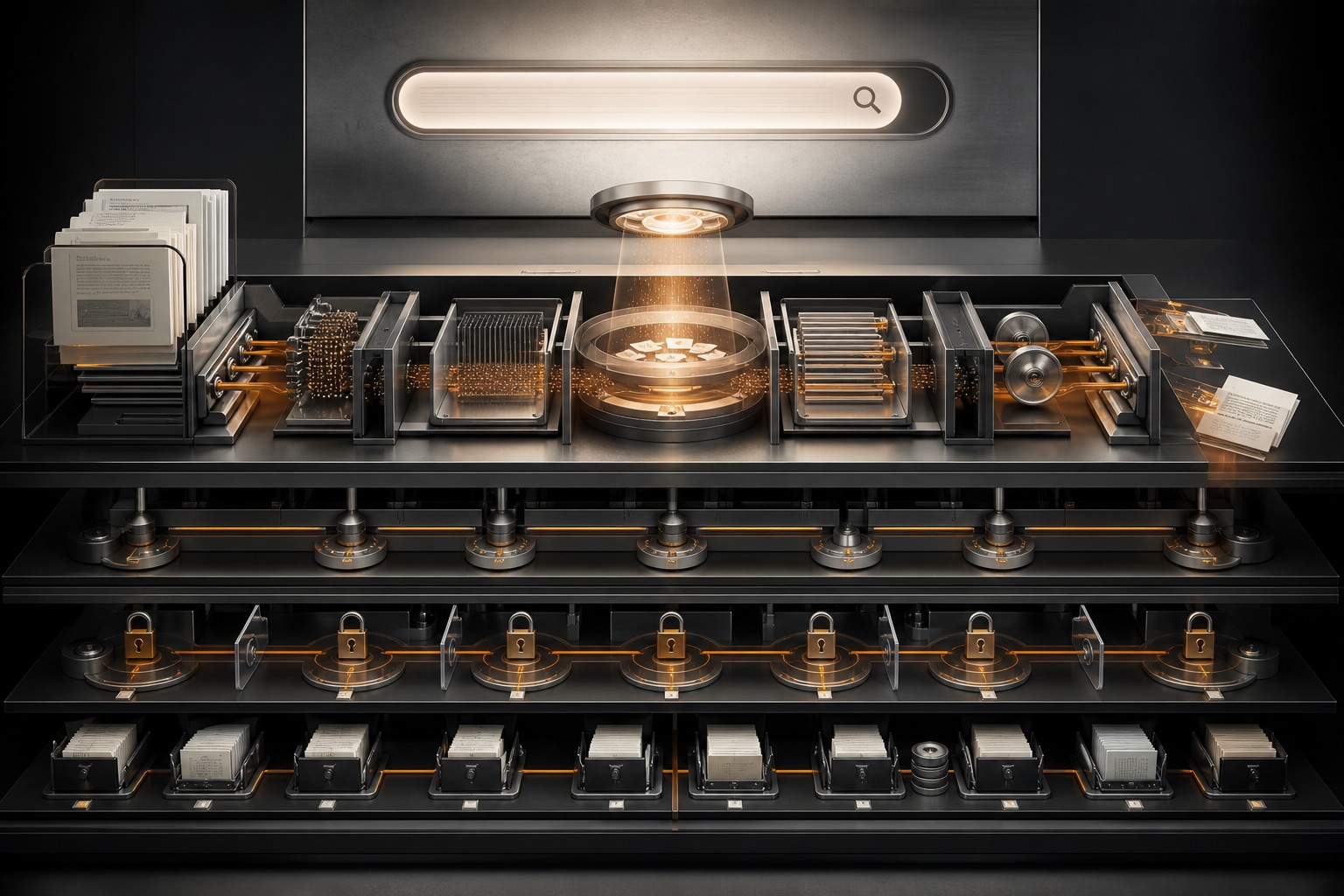
Short answer: A good RAG chatbot retrieves relevant, approved content before generating an answer and shows its sources. Its quality depends on data preparation and evaluation as much as the chat interface.
Build the smallest retrieval path
Choose a narrow public or self-created document set, extract clean text, split it carefully, store retrievable chunks, and return the supporting source with every answer. Start with a few known questions.
Evaluate more than fluent answers
Test whether the answer is supported by the retrieved text, whether it cites the right source, how it behaves when the answer is missing, and whether it avoids inventing details.
Deploy with a transparent scope
Make the dataset, intended user, and limitations visible in the demo. A small well-tested assistant is a better portfolio artifact than a broad chatbot with unknown sources.
Build the pipeline in inspectable stages
Start with a small, legal-to-use document set. Extract text, remove headers and repeated noise, split content into chunks that preserve meaning, attach document metadata, and store each chunk with its source location. At question time, retrieve candidates, rank them, and pass only the relevant evidence to the answer step.
In the interface, show the source title and relevant excerpt or link next to the answer. If the retrieved text does not support an answer, the chatbot should say that it cannot find support in the current collection. This is more useful than a fluent unsupported response.
Create an evaluation sheet before polishing the UI
Write 20–30 questions with expected supporting documents. Include direct questions, paraphrases, multi-part questions, questions with no answer, and questions designed to confuse the system. Record retrieval quality separately from answer quality; a good model cannot rescue missing evidence.
For each release, note grounded-answer rate, citation correctness, no-answer behaviour, latency, and the failures you fixed. This evaluation sheet becomes strong portfolio evidence because it shows how you tested a system rather than merely calling an API.
The chat window is the last part of a RAG project
The visible chat interface is often the fastest component to build, which is why students sometimes start there. The harder and more valuable work sits behind it: preparing source material, preserving metadata, retrieving the right passages, testing unsupported questions, and showing citations. Those layers determine whether a chatbot is genuinely grounded or simply produces plausible text.
Build the interface only after you can inspect the path from question to source to answer. When a response is wrong, you should know whether the retrieval missed the right chunk, the documents were incomplete, or the answer layer ignored the evidence. That diagnostic ability is what makes a RAG project a meaningful engineering exercise.
A realistic data-to-answer walkthrough
Start with one document set that you can legally share. Clean the documents, keep their titles and source links, and split the text in a way that preserves context. Then test retrieval separately: for each planned question, inspect the passages returned before asking the model to write an answer. This simple habit prevents you from blaming the answer model for a retrieval problem.
When you add answer generation, instruct the system to use only the retrieved evidence and to say when that evidence is insufficient. In the interface, make the citation visible and clickable. A reviewer should not have to take your word that an answer is grounded; they should be able to inspect the source themselves.
Deployment can remain simple. A small hosted demonstration or local recording is enough if it explains the data, scope, and limitations. The technical value comes from the quality of the pipeline and evaluation, not from pretending that a narrow document chatbot is ready to answer every question on the internet.